
What Is KYC Verification? How It Works at Online Casinos
KYC verification at online casinos is the process of confirming who you are before the platform lets you withdraw funds, claim certain bonuses, or raise deposit limits. If you have ever been asked to upload a passport or a utility bill after signing up, that is KYC in action. KYC stands for Know Your Customer. […]

KYC verification at online casinos is the process of confirming who you are before the platform lets you withdraw funds, claim certain bonuses, or raise deposit limits. If you have ever been asked to upload a passport or a utility bill after signing up, that is KYC in action.
KYC stands for Know Your Customer. It is a global compliance standard that financial institutions, banks, and licensed gambling platforms are legally required to follow. For players, it can feel like an interruption. In practice, it is a one-time step that unlocks full account access and protects you from fraud and identity theft at the same time.
This guide explains what KYC is, which documents you will need, how long the process takes, and how to complete it without delays. It also covers why crypto casinos still run KYC checks, and what it means when a site says it is “no-KYC.”
What KYC Actually Means
KYC, or Know Your Customer, is an identity verification process that licensed gambling platforms use to confirm the age, identity, and financial information of every account holder before allowing withdrawals or high-value activity.
KYC is not a casino invention. It originates from international anti-money laundering regulations, specifically the Financial Action Task Force (FATF) standards adopted by regulators worldwide. Casinos that hold a license from bodies like the Malta Gaming Authority, the UK Gambling Commission, or Curaçao eGaming are contractually required to collect and verify player identity data.
The practical purpose is threefold:
- Prevent underage gambling by confirming date of birth
- Stop fraud and identity theft by matching documents to account details
- Support anti-money laundering (AML) compliance by verifying the source of funds when needed
Without passing KYC, players at regulated casinos typically cannot process withdrawals, and sometimes cannot make deposits above a set threshold.

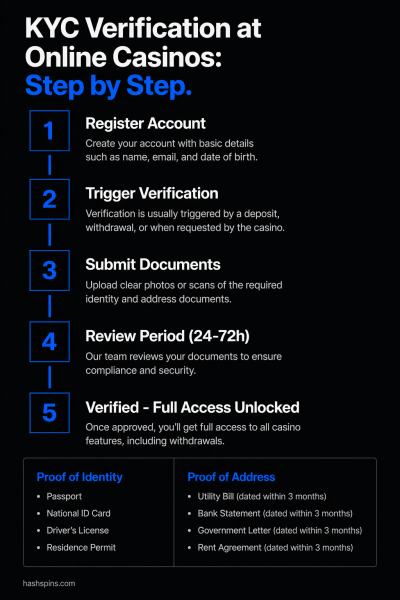
Which Documents Does KYC Require?
Most online casinos require two core document types: proof of identity and proof of address. Some platforms also request payment method verification for withdrawals above a certain amount.
Proof of Identity
Any valid government-issued document that shows your full name, date of birth, and photograph:
- Passport (most widely accepted)
- National ID card
- Driver’s license
The document must be valid and not expired. Upload a clean, fully visible scan or photo with no corners cropped and no text obscured. Proof of identity is often shortened to “POI”.
Proof of Address
A recent document confirming your residential address matches the information on your account:
- Utility bill (electricity, gas, water, internet)
- Bank statement
- Official government letter or tax document
The document must be dated within the last three months and must show your full name and address clearly. Obviously, similar to POI, proof of address is often shortened to “POA”.
Payment Method Verification
When withdrawing via card or bank transfer, some platforms request a screenshot or scan confirming ownership of the payment method. For crypto wallets, some casinos ask for a brief transaction history or wallet address confirmation, though this varies significantly by operator.

How Long Does KYC Take?
Standard KYC verification at most online casinos takes between 24 and 72 hours. Some platforms process documents within a few hours, particularly if your upload is clear and the details match your account exactly.
Delays typically happen for predictable reasons: blurry or cropped document images, mismatched names or addresses between documents and the account profile, expired ID, or documents older than three months for proof of address. Fixing these issues usually restarts the review clock, so it pays to check every file carefully before submitting.
Enhanced due diligence (EDD) can extend the timeline considerably. EDD applies when accounts show high transaction volumes, when players are categorized as politically exposed persons (PEPs), or when the platform flags activity that requires source-of-funds documentation. In those cases, verification can take several business days and may involve additional paperwork.
KYC at Crypto Casinos: What Is Different?
Crypto casinos do still run KYC. The common belief that crypto equals no verification is inaccurate for licensed platforms. Because cryptocurrency offers a degree of pseudonymity, licensed crypto-accepting casinos are often held to strict AML requirements by their regulators, which means KYC is just as standard there as at traditional online casinos.
However, the experience can differ in a few practical ways:
- Crypto casinos may allow smaller initial deposits or free-play without KYC, triggering verification only at the withdrawal stage
- Verification of crypto payment methods may involve wallet address confirmation rather than a card scan
- Some offshore or unlicensed platforms operating under minimal regulatory oversight do function without KYC checks, though this raises significant player protection concerns
The distinction matters: a licensed crypto casino accepts Bitcoin, Ethereum, or stablecoins for payments but still operates under a compliance framework. Truly “no-KYC” sites typically either operate in unregulated jurisdictions or rely on blockchain pseudonymity to sidestep regulatory requirements. Neither is without risk for players.
Casinos With Transparent KYC Processes
BC.Game
BC.Game is a crypto-native casino with a clear, step-by-step KYC flow accessible directly from account settings. The platform asks for a government-issued ID and proof of address, and processes submissions quickly, often within a few hours for straightforward cases. BC.Game’s verification unlocks higher withdrawal limits, full bonus eligibility, and faster processing on payouts. It is a strong first choice for players who want a well-documented verification experience on a platform built around crypto. Visit the BC.Game page for the latest deposit and withdrawal details.
Duelbits
Duelbits handles KYC in the context of a competitive, esports-adjacent crypto casino. Verification here follows standard document requirements but the platform is transparent about why it collects data and what changes once you are verified. Check the Duelbits page for current bonus and account details.
Bitstarz
Bitstarz is one of the most established crypto-accepting casinos online and has a well-tested compliance process. Its KYC workflow is straightforward, and the platform has a reliable track record for processing documents without long delays. See the Bitstarz page for the full current offer.
Wild.io
Wild.io operates with a clean onboarding process and clear KYC documentation requirements. The platform is particularly accessible for newer players trying to understand what verification involves before committing. Visit the Wild.io page to compare the current offer.
Betpanda
Betpanda runs a fast verification process and communicates clearly about the documents needed. Players report a smooth experience when submitted files are clean and details are consistent. Check the Betpanda page for account and bonus information.
Vave
Vave accepts crypto and supports a range of international players. Its KYC process is standard and well-documented, with clear instructions on document formats and accepted file types. See the Vave page for full details.
KYC Verification: Key Requirements at a Glance
| Document Type | Accepted Examples | Key Requirement |
|---|---|---|
| Proof of Identity | Passport, driver’s license, national ID | Valid, not expired, shows full name and date of birth |
| Proof of Address | Utility bill, bank statement, government letter | Dated within last 3 months, matches account details |
| Payment Method | Card scan, e-wallet screenshot, wallet address | Shows account holder name and relevant account details |
| Source of Funds | Bank statement, payslip, tax document | Required for high-value or flagged accounts only |
| Selfie / Liveness Check | Photo holding ID, live video check | Requested by some platforms to prevent identity fraud |
What KYC Gets Right, and Where It Creates Friction
KYC verification serves real, important purposes. Here is what it does well:
- Protects players from identity fraud and account takeovers
- Blocks minors from accessing real-money gambling platforms
- Ensures regulated casinos stay compliant with licensing bodies
- Reduces money laundering risk across the industry
- Speeds up large withdrawals once verification is completed and on file
- Builds long-term trust between the platform and verified players
That said, verification has genuine friction points players should understand:
- Submitting documents for the first time can delay your first withdrawal by 24 to 72 hours or longer
- Players in certain jurisdictions may face enhanced checks and additional document requests
- If your account details do not exactly match your documents, expect the process to restart from scratch
Understanding KYC: The Bottom Line
KYC verification at online casinos exists because regulators require it, and because it protects both the platform and the player. Understanding what KYC means from the start saves time, reduces frustration, and helps you choose a casino with a transparent, well-run compliance process. The platforms that handle verification well are almost always the ones that handle withdrawals, disputes, and player protection well, too.
Quick Answers About KYC Verification
Does every online casino require KYC? Licensed casinos are legally required to verify player identity before processing withdrawals. Unlicensed or offshore platforms may not enforce KYC, but this usually means lower player protections overall. If a site skips verification entirely with no explanation, treat that as a red flag.
Can I play before completing KYC? Yes, in most cases. Most casinos allow you to register, deposit, and play before verifying. Verification is typically triggered when you request your first withdrawal or when your account activity exceeds a threshold. Some platforms require earlier verification to claim welcome bonuses.
What happens if my KYC is rejected? The casino will usually tell you exactly which document failed and why. Common reasons include blurry images, expired ID, or an address mismatch. Correct the issue and resubmit. If you are repeatedly rejected despite clean documents, contact support directly.
Is my data safe when I submit KYC documents? Licensed casinos are required by data protection regulations to store your documents securely and use them only for compliance purposes. Look for casinos holding licenses from Malta, Gibraltar, or Isle of Man, as these jurisdictions enforce strong data protection standards.
What is source-of-funds verification and when does it apply? Source-of-funds checks go beyond identity verification and ask you to prove that the money you are gambling with is legitimately earned. This is applied to high-value accounts, politically exposed persons, or when transaction patterns trigger AML alerts. It is not standard for most casual players.
Table of Contents
More Guides Worth Reading

Learn Before You Play: Casino Guides
Crypto gambling has a learning curve. Our guides explain the terms, tools, and mechanics that matter most, from wagering requirements to wallet setup, so you can avoid costly mistakes and play with greater confidence.
