
Provably Fair Casinos: The Complete Guide to How It Works and What It Actually Proves
Provably fair is the cryptographic standard that lets players verify every game result at a crypto casino without trusting the operator. If you’ve seen the term on a dice or crash site and wondered what it actually guarantees, this article covers every layer: the mechanics, the real limits, which casinos do it well, and what […]

Provably fair is the cryptographic standard that lets players verify every game result at a crypto casino without trusting the operator. If you’ve seen the term on a dice or crash site and wondered what it actually guarantees, this article covers every layer: the mechanics, the real limits, which casinos do it well, and what to check before you play.
What Provably Fair Actually Means
Provably fair is a verification system based on cryptographic hashing that allows players to confirm game outcomes were not manipulated. It applies primarily to crypto casinos running in-house games such as dice, crash, coinflip, and plinko.
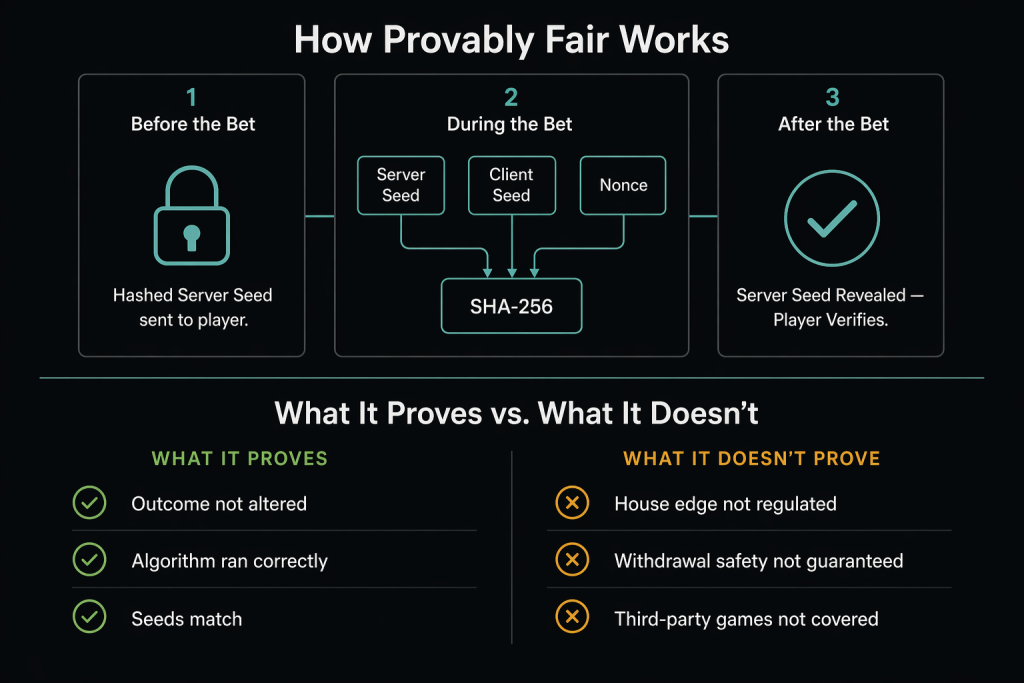
At its core, the system uses three components:
- Server seed: a random string generated by the casino before a round, hashed and shared with the player in advance
- Client seed: a value generated by the player’s browser or entered manually
- Nonce: an incrementing counter tied to each individual bet
These three inputs are combined using a cryptographic algorithm to produce the game result. Because the hashed server seed is provided before the bet is placed, the casino cannot change it mid-session without detection. After the round ends, the casino reveals the original seed. The player can then verify that it matches the hash and that the final outcome was correctly calculated from those inputs.
In practice, most players never perform a manual check. However, the option to verify creates accountability that anonymous RNG casinos cannot offer.
How the Verification Process Works Step by Step
The verification process is sequential and repeatable, which is precisely what gives it value.

Before a bet is placed, the casino hashes the server seed using SHA-256 and sends that hash to the player. This is equivalent to a sealed envelope: you can confirm the hash was genuine after the fact, but you cannot reverse-engineer the original seed from it. The player then places a bet. The client seed and nonce are combined with the server seed to generate the outcome. After the round, the casino reveals the unhashed server seed. Using a tool such as an HMAC-SHA256 verifier, the player can hash that seed independently and confirm it matches what they were given before play began. They can also recalculate the full result from all three inputs and check that it aligns with what the game displayed.
If the hash does not match, the casino tampered with the seed. If the recalculated result does not match the displayed outcome, the result was manipulated. Either way, there is a cryptographically verifiable record.
This process works cleanly for in-house games. Slots, live dealer tables, and third-party titles are not built around this system. Most operators that support provably fair do so only for their original game catalogue, and that distinction matters when you are choosing where to play.
What Provably Fair Does Not Prove
This is where most articles fall short. Understanding the limits of provably fair is just as important as understanding how it works.
Provably fair confirms that the outcome of a specific game round was not altered after the bet was placed. It does not confirm anything else. Specifically, it does not prove that the house edge is reasonable, that the operator is solvent, that withdrawals will be processed, or that bonus terms will be honoured. A game can be entirely provably fair and still carry a 5% house edge on every roll. The maths still favours the house. Fairness in the cryptographic sense means accuracy, not generosity.
There are also implementation risks. Some operators map large hash outputs into game results using modulo operations that introduce subtle probability bias. Nonce handling is sometimes opaque, making it difficult to tie specific bets to specific verification records. Perhaps most importantly, many casinos apply provably fair only to their proprietary games while sourcing slots and live tables from providers that operate standard server-side RNG. That is not inherently dishonest, but it needs to be disclosed clearly.

The Gambling Commission’s guidance on RNG and game integrity reflects this distinction: cryptographic verifiability and regulatory compliance are separate standards. One does not substitute for the other.
Casinos That Use Provably Fair Effectively
Not every crypto casino approaches provably fair the same way. These five operators from the HashSpins approved pool represent a range of implementations worth knowing.
Duelbits runs a dedicated provably fair system across its original game suite, including crash, dice, and several proprietary titles. The verification interface is built directly into each game, so players can audit results without leaving the page. The platform’s transparent approach to game mechanics has made it a reliable choice for players who actually intend to verify their sessions.
Wild.io integrates provably fair into its in-house game collection and includes a clear explanation of the system in the help section. The platform accepts multiple cryptocurrencies and is positioned toward players who want straightforward crypto gambling without unnecessary friction. Visit the Wild.io page for current bonus details and the full game list.
Kryptosino is a crypto-focused casino that publishes verifiable game results for its original titles. The site runs a cleaner-than-average implementation with well-documented seed management, including clear policies on when server seeds are rotated. Check the Kryptosino page for the latest offer and available markets.
Other Real Examples
Vave supports provably fair across dice and crash variants and pairs this with a broad sportsbook and standard casino catalogue. The combination is relevant because it illustrates the mixed model clearly: some games are verifiable, third-party slots are not. That transparency about the distinction is actually a positive sign. See the Vave page to compare the current bonus and terms.

Bitz runs provably fair for its original game set and has a functional verification tool built into the account area. It is a leaner platform in terms of overall library size, but the games it does offer are well-implemented and the fairness documentation is accessible without needing to contact support.
Provably Fair Implementation: How Casinos Compare
The following table summarises how provably fair is typically implemented across crypto casino categories.
| Feature | Strong implementation | Weak implementation |
|---|---|---|
| Scope of verifiable games | All in-house titles clearly labelled | Only some games, no disclosure |
| Verification tool | Built into the game interface | External tool required, poorly documented |
| Nonce transparency | Clearly mapped to individual bets | Opaque or not shown |
| Seed rotation policy | Disclosed in help docs | Not explained |
| Hash function used | SHA-256 or HMAC-SHA256 | Unstated or proprietary |
| Third-party game disclosure | Clearly separated as RNG only | Mixed in without clarification |
A casino that scores well across these criteria treats provably fair as a genuine transparency tool. One that buries the verification page three menus deep is using it as a marketing badge without the substance behind it.
Pros and the Tradeoffs Worth Knowing
Provably fair offers real advantages over conventional online casinos.
- Cryptographic proof that outcomes were not changed after bets are placed
- Player-controlled client seed creates input the casino cannot predict
- Full audit trail available for every session on supported games
- No reliance on third-party auditors for in-house game verification
- Operates without a licensing body needing to confirm game integrity
- Creates a public standard that incentivises honest game implementation
That said, these tradeoffs apply:
- The system only covers in-house games; slots, live dealer, and third-party titles remain outside this framework at most operators
- Very few players actually perform manual verification, so the practical value depends on the option existing rather than being used
- Provably fair cannot protect you against insolvency, withdrawal blocks, or bonus disputes; operator trust and licensing remain separate, necessary evaluations
The Real Verdict on Provably Fair Gaming
Provably fair is one of the most meaningful transparency tools in crypto casino gaming. It gives players genuine cryptographic proof that in-house game results were not manipulated, which is a stronger guarantee than what most traditional online casinos can offer through server-side RNG alone. For dice, crash, coinflip, and similar formats, it sets a verifiable standard that holds up technically.
However, provably fair is not a complete safety certificate. It does not replace licensing, proof of reserves, or honest bonus handling. Treating it as one strong signal among several, rather than as final proof that an operator is trustworthy in every dimension, gives you a more accurate picture of what you are working with.
Quick answers about provably fair gaming
Q: Can a provably fair casino still cheat players? Yes, in areas outside the cryptographic system. A casino can have a valid provably fair system for dice and still delay withdrawals, impose unfair bonus conditions, or refuse to pay. Provably fair is a game-level tool, not an operator-level guarantee.
Q: Do all games at a provably fair casino use the system? No. Most provably fair casinos apply the system only to their original in-house titles. Slots sourced from providers like Pragmatic Play or Evolution’s live dealer tables use standard RNG and are not verifiable using the same method.
Q: What hash function do provably fair casinos use? The most common implementation uses SHA-256 or HMAC-SHA256. These are the same cryptographic standards used in Bitcoin transaction verification, which is why they are considered reliable for this application.
Q: Is it difficult to verify a result manually? The process is straightforward if the casino provides a clean verification page. You need the revealed server seed, your client seed, the nonce, and a hash calculator. The entire check takes under two minutes once you have done it once.
Q: Does provably fair mean the house edge is disclosed? Not automatically. The cryptographic system confirms that the algorithm ran correctly, but it does not surface the house edge unless the casino publishes it alongside the game. Always check the published RTP or house edge separately before playing.
Table of Contents
More Guides Worth Reading


Learn Before You Play: Casino Guides
Crypto gambling has a learning curve. Our guides explain the terms, tools, and mechanics that matter most, from wagering requirements to wallet setup, so you can avoid costly mistakes and play with greater confidence.